
There is a kind of exhaustion that quietly develops in many people who spend years searching within spiritual spaces.
At first, the search often feels hopeful. You discover meditation, Reiki, mindfulness, healing work, spiritual teachings, or practices that genuinely help you. Something opens. You begin feeling more connected to yourself. More aware. More alive.
But over time, many people begin accumulating far more spiritual information than they are actually able to live.
There is always another book to read, another workshop to attend, another modality to learn, another teacher to follow, another experience that promises deeper healing or transformation. Without realizing it, spirituality can slowly become another form of consumption.
I do not say that critically. I understand it because I lived inside that pattern for years.
Like many people drawn toward Reiki, I was genuinely searching for healing, peace, clarity, and connection. Some of the experiences I had during those years were deeply meaningful. Some changed the direction of my life. But eventually I began noticing something uncomfortable: I was spending a great deal of time searching, learning, and consuming spiritual material, but much less time simply practicing consistently.
The deeper I went into Reiki, the more I began to feel that the heart of the practice was not really about accumulating more experiences, techniques, or information. It was about returning to simple practices repeatedly enough that they gradually began changing how I lived.
That realization slowly became one of the central philosophies behind The Reiki Society:
Reiki is not something you consume. It is something you practice.
For me, that sentence is not just branding or positioning. It feels like a genuine distinction between two very different relationships with spirituality.
One is centered around accumulation.
The other is centered around embodiment.
The Culture of Spiritual Consumption
Modern spiritual culture often encourages people to keep searching.
People collect modalities, certifications, healing sessions, teachings, rituals, practices, and experiences. Many spend years moving from one thing to another, hoping that eventually they will arrive at some lasting sense of peace, healing, or completion.
Again, I do not think most people are insincere. I think many are genuinely suffering. Many are overwhelmed, emotionally exhausted, disconnected from themselves, and searching for relief.
But one of the difficult truths I had to confront in my own life was that constantly consuming spiritual material can sometimes create the feeling of movement without requiring the slower work of transformation.
Learning something new feels productive.
Attending a workshop feels meaningful.
Having a powerful spiritual experience feels life-changing.
And sometimes those things truly are important.
But none of them automatically change the structure of our daily lives.
None of them guarantee that we become more grounded, more present, more disciplined, or more honest with ourselves.
At some point, I had to begin asking a much simpler question:
How am I actually living?
Eventually, I realized the deeper question was no longer what I understood intellectually, what spiritual experiences I had once reached, or which teachings resonated with me emotionally. What mattered more was how I was actually living each day, and whether the practice was genuinely changing the way I related to myself, others, and ordinary life.
How was I actually living on ordinary days?
That question changed the direction of my practice.
Because eventually I realized that many of the things I was searching for could not be found through endless accumulation. They could only be cultivated through repeated return.
Reiki as Daily Practice
One of the things that deeply impacted me as I studied more traditional approaches to Reiki was how strongly they emphasized consistency, self-cultivation, and daily practice.
Not intensity.
Not performance.
Not endless complexity.
Just practice.
Meditation.
Self-Reiki.
Breath.
Awareness.
Reflection on the Gokai.
Returning to the present moment.
Simple things repeated over long periods of time.
At first, that simplicity can almost feel underwhelming. Especially in modern spiritual culture, where there is often a constant emphasis on extraordinary experiences, advanced techniques, energetic upgrades, or emotional intensity.
But eventually I began realizing that the simplicity was not a limitation of the practice. It was the depth of the practice.
Traditional Reiki places much less emphasis on dramatic experiences and much more emphasis on consistency. The practice develops gradually through repeated daily engagement rather than emotional intensity or spiritual performance.
That perspective shifted something important in me.
Instead of constantly asking what else I needed to add, I began asking what would happen if I simply practiced sincerely and consistently over time.
That question still feels central to me now.
The Difference Between Knowing and Living
There is a profound difference between understanding spiritual ideas intellectually and embodying them in daily life.
Someone can speak beautifully about mindfulness while remaining deeply disconnected from themselves.
Someone can discuss compassion while still living in constant resentment or reactivity.
Someone can know the Five Principles of Reiki by memory while rarely practicing them when life becomes difficult.
I say this carefully because I do not think any of us embody these principles perfectly. I certainly do not.
But I think genuine practice begins when we stop treating spiritual teachings primarily as concepts to admire and begin relating to them as things to live.
That shift is much quieter than many people expect.
It often looks very ordinary.
Continuing to practice even when you do not feel inspired.
Learning how to remain present during stressful moments.
Returning to gratitude during difficult seasons.
Noticing your patterns honestly instead of spiritually bypassing them.
Learning how to regulate your nervous system rather than constantly chasing stimulation.
That kind of work rarely looks dramatic from the outside. But over time, it changes people deeply.
And honestly, I think this is why repetition matters so much.
Transformation rarely happens through occasional intensity alone. It happens through sustained relationship with practice.
Chasing Experiences
There was a period in my own path where I became very attached to spiritual experiences.
Feelings of openness.
Connection.
Stillness.
Flow.
Moments where life felt deeply unified or sacred.
Some of those experiences were real and meaningful. But over time, I slowly became attached to them. I wanted to return to them. I wanted to remain inside them permanently.
When those states faded, I struggled.
I thought I had lost something.
But looking back now, I think one of the most important parts of my path was learning that no state—no matter how beautiful—is permanent.
Eventually I had to stop organizing my practice around chasing experiences and begin learning how to live within ordinary life again.
That shift was humbling.
It forced me to ask whether my relationship with spirituality was actually helping me become more grounded and present, or whether I was simply searching for moments that temporarily allowed me to escape discomfort.
I think this is one of the reasons many people become trapped in cycles of workshop addiction or spiritual intensity. Powerful experiences can temporarily create feelings of clarity, expansion, emotional release, or connection. And there is nothing inherently wrong with those experiences.
But eventually the workshop ends.
The retreat ends.
The ceremony ends.
And then life continues.
The deeper question becomes: who are we when the intensity fades?
Can we continue practicing during ordinary life?
Can we remain committed when practice no longer feels exciting?
Can we continue returning without needing constant emotional reward?
That, to me, feels much closer to mature spiritual practice.
Reiki and the Ordinary Day
The longer I practice, the less interested I become in separating spirituality from ordinary life.
I no longer think the deepest value of Reiki exists only in sessions, rituals, or extraordinary experiences. I think its deepest value is revealed gradually through how it changes the way we live.
Over time, practice began feeling less connected to spiritual ideas and more connected to ordinary life — how we respond to stress, how we speak to people, how we care for our body, how we breathe, how we sit with discomfort, how we move through conflict, and how we relate to ourselves during uncertain seasons. Those quiet moments often reveal much more about the depth of our practice than any spiritual experience ever could.
The Five Principles themselves point toward this kind of embodiment.
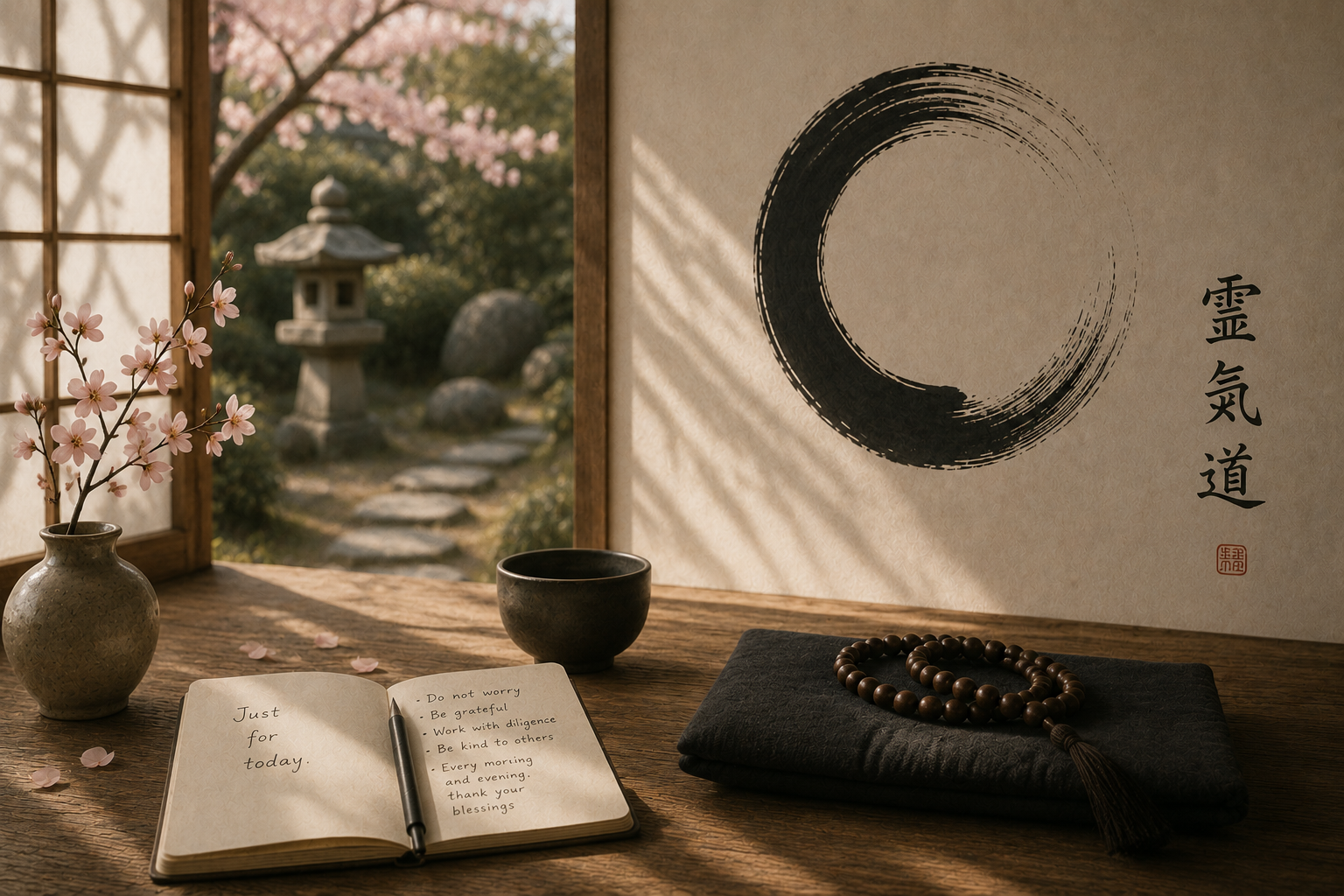
“Do not anger.”
“Do not worry.”
“Be grateful.”
“Practice diligently.”
“Be kind to others.”
These are not abstract affirmations meant to sound inspiring. They are practices. And practices only become meaningful through repetition.
I think “Just for Today” has become especially meaningful to me because it helps interrupt the tendency to abandon the present moment while searching for some imagined future state of wholeness.
For a long time, I was always trying to get somewhere else spiritually. Trying to return to previous experiences. Trying to become a better or more awakened version of myself.
But “Just for Today” keeps bringing me back to where life is actually happening.
Today.
This ordinary moment.
This breath.
This conversation.
This difficult season.
This imperfect life.
That has become much more meaningful to me than chasing constant spiritual intensity.
The Dojo Mindset
One of the ideas that has become increasingly important to me is the idea of practice culture.
What began mattering more to me over time was not spirituality as identity, performance, or endless consumption, but the development of an actual practice culture. A life rooted in steady, ongoing engagement with simple practices gradually felt far more meaningful than constantly searching for new experiences, new teachings, or new ways to appear spiritual.
This is one of the reasons the idea of the Dojo resonates with me so deeply.
The Dojo mindset is rooted in consistency, repetition, humility, and long-term engagement. It is less concerned with appearing spiritually advanced and more concerned with simply continuing to return.
You practice whether the session feels profound or ordinary.
You continue whether motivation is high or low.
You stop measuring progress only through emotional intensity and begin trusting the quieter effects of sustained practice.
I think this is very different from how many people approach spirituality today.
Modern culture often trains people to seek novelty constantly. There is pressure to keep consuming, upgrading, achieving, or experiencing something new.
But depth usually develops differently.
Depth develops through relationship.
Through continuity.
Through staying with simple practices long enough for them to begin reshaping the way you live.
That is one of the reasons I increasingly believe that structure matters.
Not rigid structure.
Not authoritarian spirituality.
But supportive rhythm.
A consistent environment that encourages people to return to practice again and again.
I think many people are starving for that kind of grounded spiritual environment without fully realizing it.
Embodiment Instead of Identity
One of the things I have become more cautious of over the years is building identity around spirituality.
It is very easy to begin identifying as spiritual without actually becoming more embodied.
People can learn spiritual language, adopt spiritual aesthetics, or construct spiritual identities while remaining deeply disconnected from themselves emotionally.
Again, I say that gently because I think most of us go through some version of this.
But eventually I began caring less about appearing spiritual and more about becoming honest.
Practice also began requiring a different kind of honesty from me. Not the kind that tries to appear spiritually evolved, but the kind that is willing to look clearly at my own reactions, inconsistency, worry, striving, and distraction. Over time, I had to acknowledge how easy it is to lose rhythm, fall out of alignment, and drift away from the practices that keep me grounded. Strangely, that honesty made the practice feel more real and more sustainable, because it was no longer built around maintaining an image of who I thought I should be.
Paradoxically, that honesty made practice feel much more genuine.
Because then practice was no longer about maintaining an image. It became about continually returning to myself with humility.
I think this is why the quieter practices have become more meaningful to me over time.
Sitting in silence.
Practicing self-Reiki consistently.
Breathing consciously.
Reflecting on the Gokai.
Learning how to remain present during ordinary life.
None of those things are particularly glamorous. But they gradually create stability.
And honestly, I think many people today are not actually searching for more stimulation. They are searching for stability, grounding, simplicity, and a way to reconnect with themselves sustainably.
Why Simplicity Matters
One of the strongest threads running through my relationship with Reiki now is the growing sense that simplicity itself has depth.
At one point, I constantly felt the need to add more. More practices. More information. More spiritual frameworks.
Now I often find myself returning to the same simple things repeatedly.
Breath.
Awareness.
Self-Reiki.
Meditation.
The Five Principles.
Presence.
Daily practice.
Not because they are simplistic, but because they are foundational.
There is a quote in my notes that continues to stay with me:
“What if Reiki was never missing anything to begin with?”
I think that question points toward something important.
Many people assume growth requires constant accumulation. But often the deeper work is learning how to stay with simple practices long enough for them to actually become embodied.
That takes patience.
And patience is increasingly rare.
Returning Instead of Searching
I no longer think the purpose of practice is to become extraordinary.
I think it is to become more present, more honest, more grounded, and more capable of living fully within ordinary life.
That is a much quieter goal than many modern spiritual narratives promote. But it feels more sustainable to me now.
The longer I practice, the more I feel that healing is less about becoming someone else and more about gradually returning to ourselves.
The longer I practice, the more I feel that healing often looks less like achieving extraordinary states and more like learning how to return — returning to awareness, returning to the body, returning to the present moment, returning to simple practice, and returning to life as it is rather than constantly wishing to be somewhere else. Not perfectly, and not permanently, but sincerely enough that over time those repeated returns begin to create a quieter kind of stability within us.
That sincerity matters more to me now than intensity.
And honestly, that is the entire philosophy behind The Reiki Society.
Not spirituality as endless consumption.
Not healing as dependency.
Not Reiki as something to complete, collect, or perform.
But Reiki as a disciplined daily practice rooted in embodiment, repetition, simplicity, and return.
Because ultimately, Reiki is not something we consume.
It is something we practice.


