
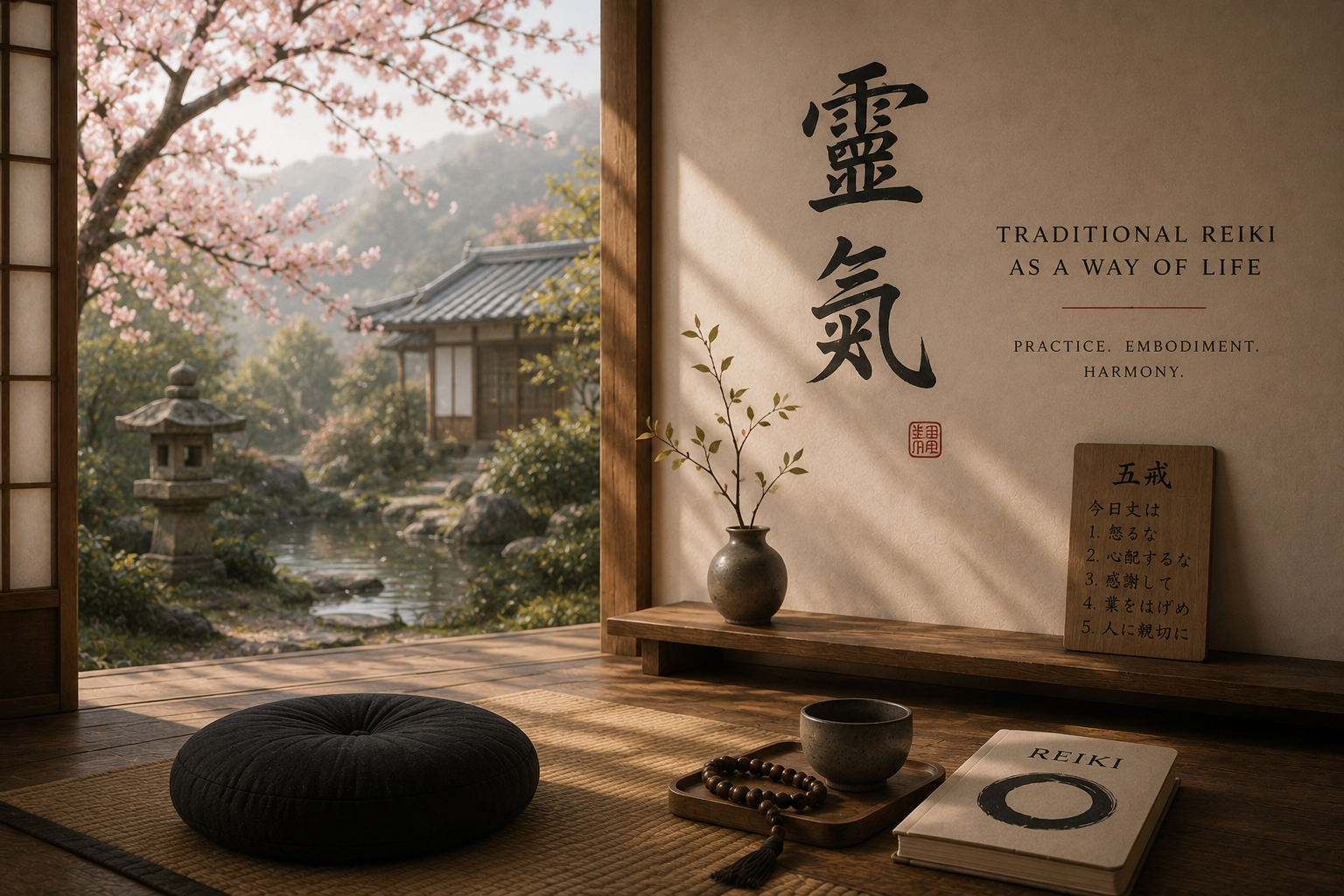
If you spend enough time exploring Reiki online, you will eventually encounter many different explanations of what Reiki is supposed to be. Some describe it primarily as energy healing. Others present it as a spiritual modality, an intuitive practice, or a system for helping people relax and heal. Over the years, Reiki has blended with many different philosophies and approaches, and as a result, it can sometimes feel difficult to understand what Reiki originally was meant to be.
For many people, Reiki becomes associated almost entirely with sessions, certifications, symbols, or techniques. While those things certainly exist within Reiki practice, Traditional Reiki points toward something much broader and much more grounded than a collection of methods. At its foundation, Reiki was intended to be a way of cultivating harmony through consistent daily practice.
That distinction matters because it changes the entire orientation of the practice.
Traditional Reiki is not primarily focused on dramatic experiences, spiritual identity, or endlessly learning new systems. Instead, it emphasizes simplicity, repetition, awareness, self-cultivation, and embodiment. It asks us to return consistently to practice, not because we are trying to become spiritually impressive, but because we are gradually learning how to live with greater balance, presence, and sincerity.
The longer I practice Reiki, the more I feel that this aspect of the tradition is often overlooked. Many people are searching for healing, peace, clarity, or spiritual connection, but they are also overwhelmed by constant information, endless techniques, and the pressure to continually seek something more. Traditional Reiki offers a quieter and more sustainable approach. Rather than encouraging endless accumulation, it invites us back into direct relationship with simple practice and ordinary life.
In many ways, that simplicity is what makes the practice so profound.
Reiki as a Way of Life
One of the biggest shifts that happened in my understanding of Reiki was realizing that it was never meant to exist only within treatment sessions or training weekends. In its traditional form, Reiki was not simply something you learned intellectually and occasionally practiced when needed. It was intended to become part of daily life.
This is one reason I resonate so strongly with the idea that Reiki is something we practice rather than something we consume.
There is a significant difference between learning about Reiki and living Reiki. Learning often stays at the level of information. Living Reiki gradually changes the way we move through ordinary life. It influences how we respond to stress, how we relate to our thoughts and emotions, how we care for ourselves, and how we relate to others.
In Traditional Reiki, the practice does not begin and end at the treatment table. The real practice happens in the middle of everyday life. It happens when we are anxious, frustrated, distracted, exhausted, or emotionally reactive. It happens when we choose to return to awareness rather than becoming completely lost in mental patterns and emotional momentum.
That kind of practice is not always dramatic, but it is deeply transformative over time.
I think many people initially come to Reiki looking for healing experiences, and there is nothing wrong with that. Reiki sessions can be supportive, calming, and meaningful. But eventually many practitioners begin realizing that the deepest changes often come from the simple practices they return to consistently.
Meditation.
Self-Reiki.
Breath awareness.
Reflection on the Five Principles.
Moments of stillness during ordinary days.
These practices may appear simple on the surface, but over time they begin to shape the nervous system, emotional patterns, and the quality of our awareness in very real ways.
Returning Instead of Striving
For a long time, I approached spiritual practice with a great deal of striving. I thought growth always needed to feel intense or extraordinary. I believed progress meant reaching higher states, maintaining alignment constantly, or holding onto powerful spiritual experiences indefinitely.
Eventually I began noticing how exhausting that mindset could become.
Moments of clarity and connection would arise, but they would also pass. Then ordinary life would return, along with fear, distraction, confusion, or emotional heaviness. For a long time, I interpreted that as failure. I felt as though I had lost something important whenever those deeper states faded.
What Traditional Reiki gradually taught me was that practice is not about permanently maintaining extraordinary experiences. It is about learning how to return.
That insight changed my relationship with practice entirely.
Instead of obsessing over whether I felt spiritually “high” or deeply aligned all the time, I began focusing more on consistency and presence. Practice became less about escaping ordinary life and more about learning how to meet ordinary life differently.
This is one reason the phrase “Just for today” has become so meaningful to me over time.
At first, the Five Principles can sound simple, almost deceptively so. But the longer you work with them, the more depth they reveal. “Just for today” is not simply motivational language. It is a way of returning attention to where life is actually unfolding.
The principle gently brings us back to the reality of where life is actually unfolding. Instead of becoming lost in the past, consumed by imagined futures, or fixated on some idealized version of who we think we should become, the practice invites us to meet ourselves honestly in the present moment. It reminds us that our life is happening here, today, exactly where we are.
That perspective softens a tremendous amount of internal struggle. It reminds us that we do not need to force ourselves into perfection. We simply continue returning to practice as honestly as we can.
The Five Principles as Embodied Practice
The Gokai, or Five Principles, sit at the center of Traditional Reiki practice. They are often displayed beautifully in Reiki spaces, but in many ways, they are much more practical than philosophical.
Just for today:
Do not anger.
Do not worry.
Be grateful.
Practice diligently.
Be kind to others.
At first glance, these principles can seem straightforward. But actually, attempting to live them reveals how deeply connected they are to awareness, emotional regulation, and self-observation.
“Do not worry” is not a demand to eliminate fear from the mind. It becomes a practice of noticing how often attention leaves the present moment and becomes consumed by imagined futures.
“Do not anger” is not about suppressing emotion or pretending frustration never arises. It is an invitation to become more aware of how anger moves through the body and mind, and to gradually develop greater steadiness and responsibility in the way we respond.
“Practice diligently” may be the principle that has affected me most deeply. For a long time, I believed transformation happened through dramatic insight or powerful spiritual experiences. Over time, I began seeing that real change usually happens much more quietly through consistent repetition.
Small practices repeated daily begin shaping us from the inside out.
This understanding aligns closely with the broader philosophy behind The Reiki Society and the idea of practice culture over certification culture.
Traditional Reiki does not place primary emphasis on accumulating techniques or endlessly advancing through systems. It emphasizes what happens after learning. How consistently do we practice? How honestly do we engage with ourselves? How deeply do these principles become integrated into the way we actually live?
Those questions eventually become more important than credentials or spiritual identity.
Why Simplicity Matters
One of the most beautiful aspects of Traditional Reiki is its simplicity.
That simplicity is sometimes misunderstood. In modern spiritual culture, there is often an assumption that more complexity equals more depth. People continue searching for more techniques, more modalities, more information, and more intense experiences. But many practitioners eventually discover that constant searching can quietly become another form of restlessness.
Traditional Reiki continually points back toward simple practice.
Breathing.
Meditation.
Self-Reiki.
Awareness.
Reflection.
Presence.
Not because these things are simplistic, but because they create a direct relationship with experience itself.
The more I practice, the more I feel that simplicity requires a different kind of discipline than constant accumulation. It is easy to chase novelty. It is harder to sit quietly with yourself every day. It is easy to consume information endlessly. It is harder to return to the same simple practices consistently, especially when life becomes difficult or motivation fades.
Yet this is often where the deepest transformation occurs.
Not through intensity, but through continuity.
This is also why I think so many people feel relieved when they encounter a more grounded understanding of Reiki. Many people are emotionally exhausted from constant striving and searching. They are not necessarily looking for another identity or another spiritual performance. They are looking for peace, clarity, steadiness, and a way to reconnect with themselves in a sustainable way.
Traditional Reiki offers a framework for that kind of practice.
Reiki Beyond Spiritual Performance
One thing I appreciate deeply about Traditional Reiki is that it feels far less concerned with appearance and far more concerned with sincerity.
Modern spiritual culture can sometimes encourage performance without realizing it. There can be subtle pressure to appear deeply healed, permanently aligned, endlessly positive, or spiritually advanced. Over time, that atmosphere can create a disconnect between how people actually feel and how they believe they are supposed to appear.
Traditional Reiki feels much quieter than that.
It emphasizes humility, consistency, and honest practice. You continue practicing not because every day feels profound, but because practice itself becomes part of how you care for your mind, body, and spirit.
Some days practice feels deeply grounding and nourishing, while other days it may feel quiet, ordinary, or even difficult. Over time, however, the value of practice becomes less dependent on how dramatic it feels in the moment and more connected to the consistency of returning to it regardless of circumstances.
But the value is not measured only by intensity or emotional reward. Over time, consistency itself begins changing the way we relate to life.
I think this is one reason the idea of the Dojo resonates so strongly with me. A Dojo is not simply a place to gather occasionally. It is a practice environment rooted in repetition, discipline, humility, and continuity.
That kind of structure is increasingly rare today. Much of modern culture encourages quick transformation and constant stimulation. Traditional Reiki offers a slower rhythm that allows practice to deepen gradually through lived experience.
Reiki as Self-Cultivation
At its heart, Traditional Reiki is a path of self-cultivation.
Not self-improvement driven by self-rejection, but a gradual process of becoming more aware, more grounded, and more aligned through consistent practice. Over time, Reiki stops feeling like a technique you occasionally use and becomes more integrated into the way you live.
As practice deepens, you naturally begin noticing your mental and emotional patterns more clearly. You become more aware of how the mind reacts under stress, how easily attention leaves the present moment, and how much of daily life is shaped by unconscious habits and emotional momentum. At the same time, you gradually develop a more stable relationship with stillness, awareness, and presence.
These changes are often subtle at first, but they accumulate over time.
This is why Traditional Reiki places such strong emphasis on practices like meditation, self-Reiki, breathwork, reflection on the Gokai, and disciplined repetition. These practices are not separate from healing. They are the foundation that allows healing and alignment to gradually emerge.
The longer I practice, the less interested I become in dramatic spiritual narratives and the more interested I become in simple embodied practice. I think many people eventually reach a similar place. They begin realizing that peace is not necessarily found through intensity or accumulation. More often, it is cultivated slowly through consistency, awareness, and learning how to remain present with life as it actually is.
That realization feels very connected to the deeper purpose of Reiki itself.
Returning to the Heart of Reiki
Traditional Reiki is not about rejecting every modern development or criticizing people who practice differently. There are many sincere practitioners walking many different paths. But I do think there is value in returning to the heart of what Reiki originally emphasized.
Practice.
Presence.
Discipline.
Simplicity.
Embodiment.
Daily life.
These things are not always glamorous, but they are deeply grounding.
The more I reflect on Reiki, the more I believe its deepest purpose is not helping us escape ordinary life but helping us participate in it more fully. Practice gradually teaches us how to remain more connected to ourselves, more aware of our patterns, and more present within the reality of everyday life.
That kind of transformation rarely happens all at once. It unfolds gradually through repeated returning.
Much of the practice ultimately comes down to learning how to return with honesty and consistency. We fall out of rhythm, become distracted, get overwhelmed, or lose perspective, and then gradually learn how to come back to ourselves again through awareness, gratitude, presence, and simple daily practice.
In many ways, this quiet process of returning may be what Traditional Reiki has been pointing toward all along.
Not becoming someone else.
Not achieving spiritual perfection.
But learning how to live with greater harmony, honesty, and presence through simple daily practice over time.


